
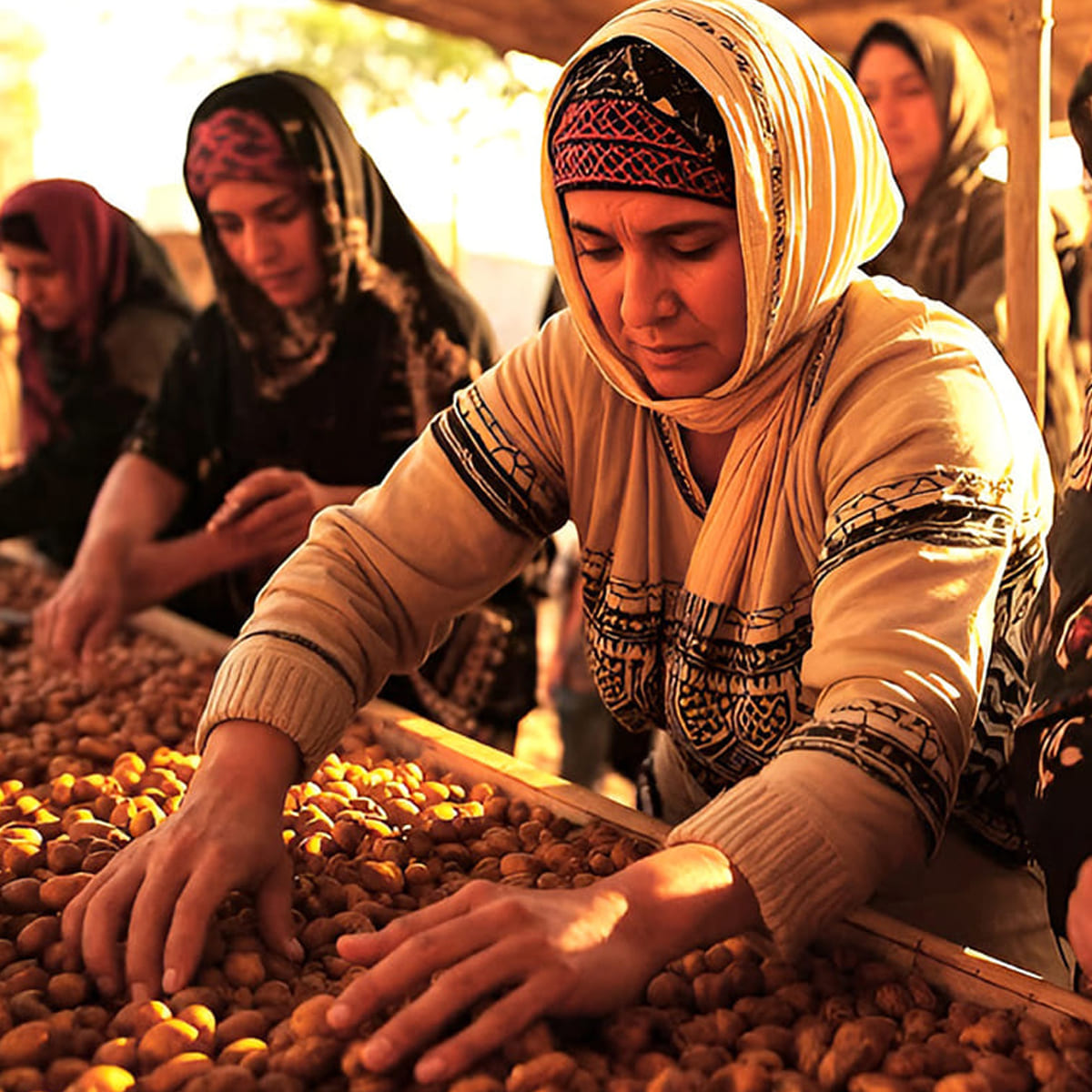
Argan Oil Women’s Cooperative Morocco: How Berber Families Transformed a Forest Resource
This article is based on first-hand knowledge of Argan Oil production in Morocco, combined with academic research and published studies. The site is the work of Malika, a Berber woman from the Argan-producing regions of Morocco, offering direct insight into traditional practices and cooperative life.
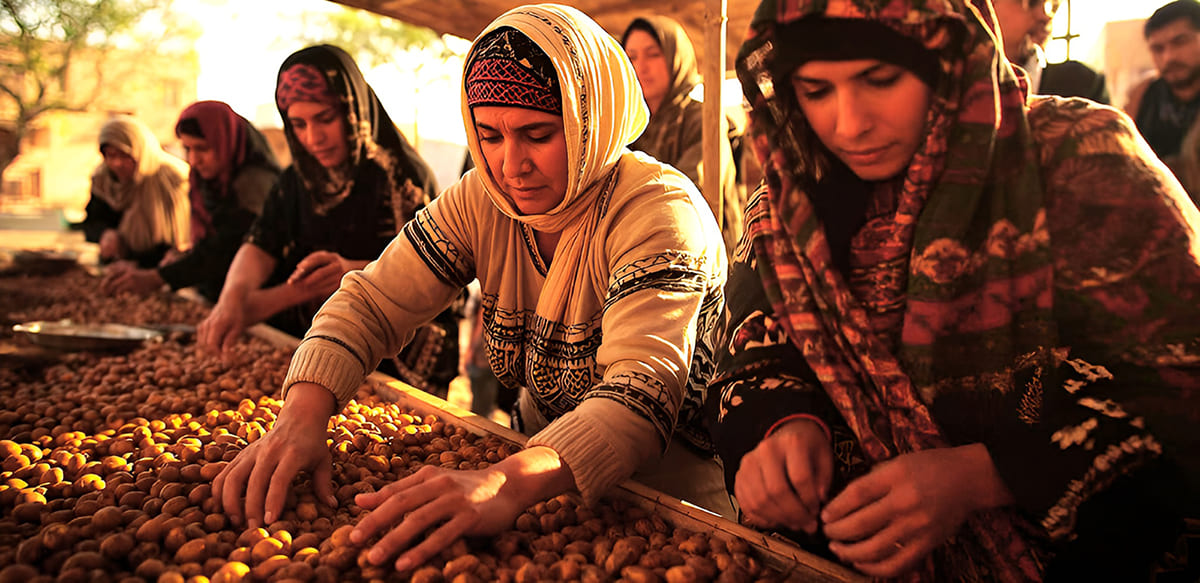
Argan oil is a natural plant oil extracted from the kernels of the Argania spinosa tree, native to Morocco. Rich in vitamin E, essential fatty acids, and antioxidants, it has been used for centuries as a food oil, a skin treatment, and a hair treatment — long before the rest of the world took notice. This is the story of how families came together to create the Argan Oil cooperatives owned by the Berber women of Morocco: a project that improved health, education, and increased members’ income by more than ten times.
Argan oil has been produced by Berber women for centuries. But it wasn’t until the formation of community-owned cooperatives that this ancient tradition became a source of lasting economic power, education, and independence for thousands of rural families.
Who Owns the Argan Trees?
Argan Oil has been made for hundreds — if not thousands — of years by the native inhabitants of Morocco, the Berbers.
In particular, the Tashelhit-speaking Berbers of the Souss occupy the land between Marrakesh to the north and just south of Agadir, and from the Atlantic coast toward the Algerian border. The argan forest grows throughout this region, with the densest groves found in the lower coastal areas and in the mountains south of Marrakesh.
The argan trees are not owned by the state or corporations. They grow on land that has been passed down through Berber families for generations — in many cases, for over a thousand years.
Traditional Argan Oil Production
Berber women traditionally prepared Argan Oil through a highly labour-intensive process with low production yields — making commercial export outside Morocco virtually impossible. Today, Argan Oil cooperatives have made large-scale production both possible and sustainable.
Families cultivate argan trees on plots of land that have been in their ownership for generations. When the argan fruits ripen in June and July, they are harvested, dried, and stored in large sacks. In the past Women then:
Traditional Technique
- Cracked the hard outer nut by hand to extract the kernel inside
- Ground the kernels using a traditional stone grindstone
- Added water to the paste to form an oil-rich dough
- Kneaded and squeezed the dough by hand to extract the oil
This was an extraordinarily labour-intensive process. Producing just 5 litres of argan oil requires approximately 20kg of kernels and around one full week of work.
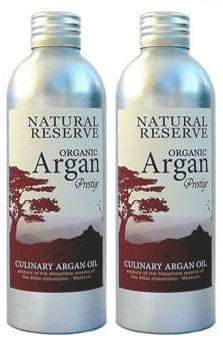
Toasted Argan Oil for Cooking & Dietary Supplement
- ✓ 100% Pure Oil — No carrier oil blends
- ✓ Handmade in Morocco — Traditional Berber extraction
- ✓ Certified Authentic — USDA, CCPB & ONSSA certified
- Free USPS 7-9 Day Tracked Shipping to U.S. Price includes U.S. import taxes.
Foreign Investors & Argan Oil Production
Until the 1990s, there was little international interest in Argan Oil, and export volumes were low. Traditional processing was sufficient to meet demand.
As worldwide interest in Argan Oil grew — driven by the cosmetics and wellness industries — foreign investors came to Morocco seeking to commercialise this resource. Modern cold-pressing plants were built in cities such as Casablanca, enabling higher production volumes, longer shelf life, and lower costs.
But this industrialisation came at a cost to local communities. Foreign investment reduced the role of Berber women to little more than raw nut suppliers, with profits flowing largely out of the region rather than back into it.
Formation of Argan Oil Cooperatives in Morocco
The transformation began with research, advocacy, and community organisation. Argan Oil expert Professor Zoubida Charrouf, from Mohamed V University in Rabat, played a pivotal role in documenting both the economic and ecological importance of the argan tree [2].
Her research helped draw international attention to the deforestation threatening argan forests — and to the potential of women-led cooperatives as a sustainable alternative to foreign-controlled extraction. The argan forest is recognised by UNESCO as an Intangible Cultural Heritage [3], and by the FAO as a model for sustainable forest management [4].
NGOs and international organisations supported the development of Berber women’s cooperatives by funding equipment, production facilities, organic certification, and business training. This enabled local communities to retain more value from production, while improving both quality and sustainability.
Today, families bring their harvest to cooperatives where nut cracking is done collectively, and oil extraction is carried out using modern cold-press machinery — preserving nutritional integrity while dramatically increasing output.
The Story of Toudarte Imsouane
The Benefits of Argan Oil Cooperatives
Increased productivity allowed the women’s cooperatives to compete on an international market, bringing much-needed income and long-term financial stability to families across the region.
Cooperative members now earn significantly higher wages — gaining independence and access to education and healthcare that were previously out of reach. Membership has increased incomes by more than ten times compared to pre-cooperative earnings, with women receiving fair wages and a share in what they have built together.
Economic Independence
Women now own shares in their cooperative and have stable income throughout the year — not just during the harvest season.
Access to Education
Cooperative profits fund literacy and numeracy programmes for members, with measurable improvements in quality of life across communities [1].
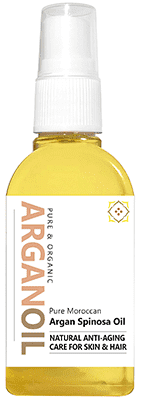
Pure double filtered Organic Argan Oil for a lighter Argan scent.
- ✓ 100% Pure Oil — No carrier oil blends
- ✓ Handmade in Morocco — Traditional Berber extraction
- ✓ Certified Authentic — USDA, CCPB & ONSSA certified
- Free USPS 7-9 Day Tracked Shipping to U.S. Price includes U.S. import taxes.
Environmental Sustainability
Cooperatives actively promote sustainable harvesting practices, tree replanting, and environmentally responsible production — helping to reverse the deforestation that previously threatened argan forest ecosystems [4].
The Impact of Literacy Programmes on Health
Improved literacy and numeracy programmes funded through cooperative income have brought major improvements in health and quality of life. Studies comparing literate and illiterate Moroccan Berber women have shown significantly better health outcomes among those with access to education — including improved maternal health, child nutrition, and chronic disease management [1].
The argan tree has sustained Berber communities for millennia. The cooperatives are ensuring that those communities, in turn, sustain the tree.
Frequently Asked Questions
Argan oil is a natural plant oil extracted from the kernels of the Argania spinosa tree, which grows almost exclusively in Morocco. It is rich in vitamin E, essential fatty acids, and antioxidants, and is widely used in cooking, skincare, and hair care. Traditionally produced by Berber women, it is one of the world’s rarest and most valuable natural oils.
Argan oil cooperatives are community-owned organisations where Berber women collectively produce, process, and sell argan oil. Members share profits, equipment, and facilities, enabling them to compete in international markets while retaining the value of their labour locally.
The cooperatives are owned and operated by their members — predominantly Berber women from rural communities in Morocco’s Souss region. They are not owned by foreign investors or corporations.
They provide fair wages, profit-sharing, access to education, healthcare funding, and long-term economic independence — particularly for women in rural areas with limited prior access to formal employment.
Yes. Long before it was a global trend, Berber women used argan oil as a traditional natural hair conditioner to protect against the Saharan winds. Their thick, healthy hair is often attributed to the regular use of this “Liquid Gold” as a scalp treatment and protectant.
In the Souss region, argan oil is traditionally applied to the scalp to “feed” the hair. By keeping the scalp hydrated and reducing inflammation, it creates the ideal environment for hair growth. While not a medicine, it is the primary ancestral remedy used by Berber families to manage thinning hair and breakage.
It supports local rural economies, preserves centuries of traditional knowledge, and protects the argan forest — a UNESCO-designated biosphere reserve — from deforestation and ecological degradation.
Yes. Cooperatives follow sustainable harvesting practices, support tree replanting programmes, and hold organic certifications — making cooperative-produced argan oil one of the most environmentally responsible options available globally.
Look for argan oil products certified as cooperative-produced and carrying fair trade or organic certification. Buying from cooperatives or verified ethical suppliers ensures your purchase benefits the communities who have stewarded these forests for generations.