
What is Argan Oil? Origins, Benefits & How to Tell a Genuine Pure Oil
Argan oil is one of the world’s rarest plant oils. In this guide, drawing on the first-hand knowledge of Malika, a Berber woman from the Souss Valley, we explore what argan oil actually is: where it comes from, what makes it nutritionally unique, and how it’s traditionally produced.
Argan oil is a rare Moroccan plant oil cold-pressed from the kernels of the argan tree fruit. Naturally rich in vitamin E, essential fatty acids, and anti-inflammatory compounds, it is used for skin, hair, and culinary purposes — and is produced almost exclusively by Berber women’s cooperatives in southwest Morocco.
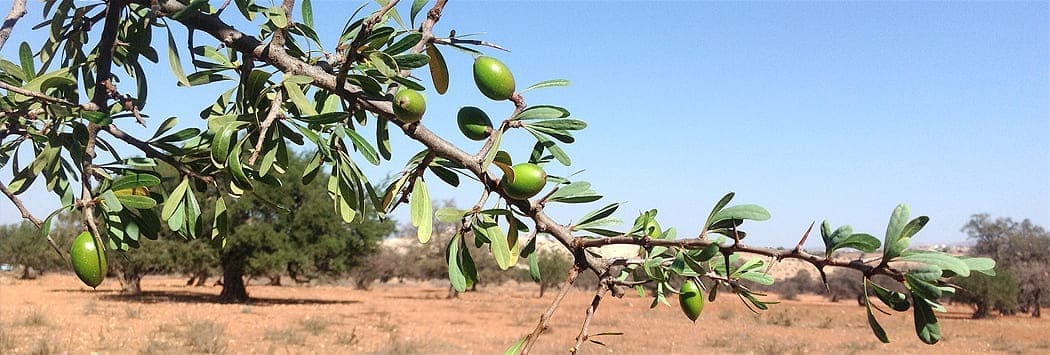
The Moroccan Argan tree, the sole source of authentic Argan Oil, grows in the arid region between Marrakech and Agadir in Morocco. It grows very slowly and produces a green fruit containing a nut which has 2–3 milky white, oil-rich kernels.
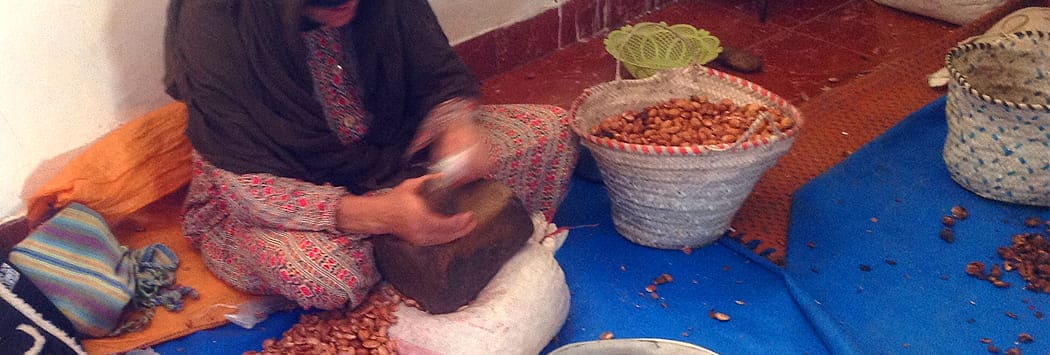
These nut kernels are extracted by hand by Berber women in cooperatives and cold-pressed into pure Argan Oil. The oil is totally natural, organic and also vegan friendly.
Buy Argan Oil & Cactus Seed Oil ⯈
Where Does Real Argan Oil Come From?
Argan oil comes exclusively from the argan tree (Argania spinosa), which grows only in a UNESCO-protected biosphere reserve in southwest Morocco — primarily between Essaouira and Agadir. No other region in the world produces authentic argan oil, making it one of the rarest and most geographically protected natural oils on the planet.
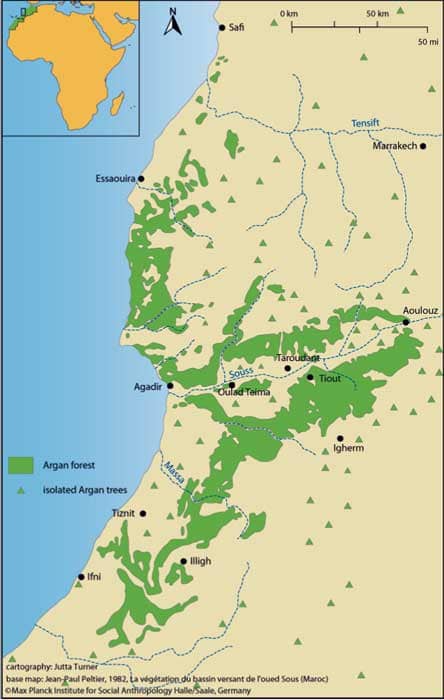
Map: Max Planck Institute for Social Anthropology: Project Turner
The Argan Tree
The argan tree is an ancient species — a relic of the Earth’s Tertiary Period, which ended approximately 1.6 million years ago. It is uniquely adapted to arid, salty soil and grows most prolifically near the Atlantic coast and in the low mountains of southwestern Morocco.
The tree may grow up to ten metres tall and can live for over 200 years. It has small silver-green leaves 2–4 cm long. In April it produces small flowers with five pale yellow-green petals.
The argan fruit it produces is 2 to 4 cm long and 1.5 to 3 cm in diameter. Each fruit has a thick, fleshy, bright green peel surrounding a hard nut held inside. It is inside that nut — in 2 or 3 pale kernels — that the oil is found.
Argan trees also play a critical ecological role. Their root systems protect soil against water loss and erosion, maintaining soil fertility and slowing desertification. A hybrid version of the argan tree is being trialled in Israel in an attempt to reclaim arid desert land.
To protect the species, UNESCO declared the argan-growing region a biosphere reserve. International support and modernisation of argan oil production have since become a model for agro-forestry and cooperative working.
The Berber Women’s Cooperatives
Argan oil is made almost exclusively by the Berber women’s cooperatives of Morocco — representing one of the most successful examples of ethical, fair-trade beauty production in the world. Today there are over 300 cooperatives across Morocco’s argan-growing regions, giving thousands of women direct control over production, pricing, and income for the first time in history.
The cooperative movement was started in the 1990s, in part by Professor Zoubida Charrouf, a Moroccan chemist who dedicated her career to preserving traditional argan production methods while empowering local communities to compete with foreign-owned industrial pressing plants.
Before the cooperatives, Berber women extracted argan oil using centuries-old hand-cracking techniques but received minimal compensation from middlemen. The work was backbreaking — it takes approximately 30 kilograms of argan fruit to produce just one litre of oil — yet the women had no direct access to markets or fair prices.
The cooperative model changed everything. By organising into collectives, these women gained direct control over production, pricing, and distribution.
When you purchase authentic, cooperative-produced argan oil, you are not just buying a skincare product — you are supporting a network of women entrepreneurs, preserving biodiversity, and investing in sustainable rural development.
The Argan Oil Production Process
Argan oil is produced by cold-pressing the kernels of dried argan tree fruits — a labour-intensive process carried out entirely by hand by Berber women’s cooperatives in southwest Morocco. It takes over 2 kg of kernels, extracted from approximately 30 kg of argan fruit, to yield a single litre of pure oil.
Harvest
Argan oil is produced by groups of families that have owned areas of argan trees for generations. When the argan fruits are ripe — 2 cm or more long and bright green — they are harvested in June or July.
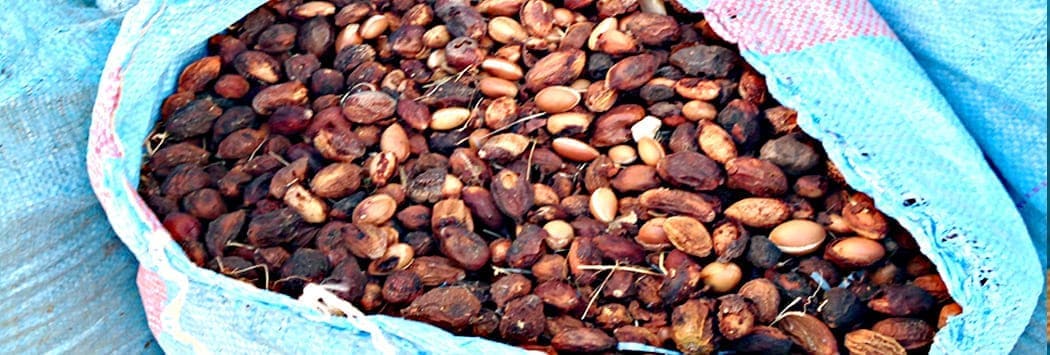
The fruits are left to dry until they form a dark brown husk. These husks are removed to reveal the brown argan nut. These nuts are exceptionally hard and the cracking process is still done entirely by hand by teams of women using stones.
Inside each nut are 2 or 3 pale yellow, bitter-tasting kernels. Over 2 kg of nut kernels are cold-pressed to extract one litre of pure oil.
Oil Extraction & Processing
After pressing, the oil is filtered to yield a yellow oil with a natural argan nut scent. This oil may be filtered a second time to produce “deodorised” argan oil, which has almost no smell and a lighter colour.
Culinary argan oil is produced differently: the nut kernels are gently toasted before cold-pressing to create an edible oil with a deep, rich nutty flavour.
💡 Top Tip: Argan Oil Vitamin E Content
Argan oil contains over twice the vitamin E (tocopherols) of olive oil — approximately 620mg per kg compared to olive oil’s 280mg. This exceptionally high tocopherol content is one of the key reasons argan oil is so effective at protecting skin cells from oxidative damage and slowing visible signs of ageing.
The Different Grades of Argan Oil
There are three main cosmetic grades of argan oil, each differing in scent, colour, and level of filtration — and choosing the right grade depends on your skin type, personal preference, and intended use. Culinary argan oil is an entirely separate product and is not suitable for skin or hair use.
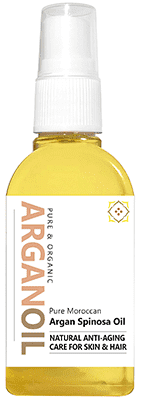
Pure double filtered Organic Argan Oil for a lighter Argan scent.
- 100% Pure Oil
- Certified Organic
- In Stock
- Quality Guarantee
- Free USPS 5-7 Day Tracked Shipping to U.S.
- Single Filtered Oil: Natural olive/citrus scent and medium yellow colour. Closest to the raw pressed oil — preferred by those who want minimal processing.
- Filtered with Active Carbon: Double filtered, lighter in colour, with a more perfumed and sweeter smell. A good middle ground for those sensitive to strong scents.
- Double Filtered Oil: The purest grade, filtered twice to remove all sediment. Pale yellow with almost no fragrance — ideal for sensitive skin or those who dislike any scent.
You can buy both single filtered scented oil and odourless argan oil on our online store.
The Ultimate Guide to Argan Oil — Free Ebook
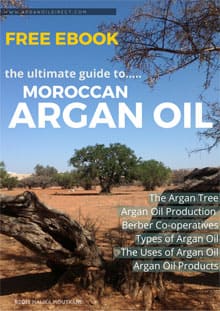
Our 34-page eBook is a complete inside guide to the history of argan oil. Learn about the origins of the forests, the chemistry of the oil, and how to use it for skin and hair care.
From Seed Kernel to Pure Oil — Video Guide
This short video walks through exactly what argan oil is made from — from argan tree fruit to finished oil — including the hand-cracking and cold-pressing process carried out by Berber women’s cooperatives in Morocco.
Argan Oil FAQs
Argan oil is one of the world’s most studied natural beauty oils — yet also one of the most misunderstood. Below are answers to the most common questions about argan oil, what it contains, and how to choose a genuine product.
What is in Moroccan argan oil?
Analysis of argan oil has revealed the specific nutrients responsible for its widely reported benefits:
- Antioxidant tocopherols (vitamin E): Over twice the vitamin E of olive oil. Helps prevent free-radical damage that ages skin cells.
- Essential fatty acids: Rich in omega-6 and omega-3 to keep skin pliable and may help reduce inflammation.
- Triterpenoids (tirucallol): Research suggests these play an important role in healing damage to the skin.
- Beta-amyrin: Associated with stimulating cell growth and collagen synthesis. [1]
- Butyrospermol: Linked to powerful anti-inflammatory effects.
- Lupenol: Known for strong antiseptic properties.
What is the difference between “Moroccan Oil” and argan oil?
“Moroccan Oil” is a name widely used to describe products which may — or in many cases may not — be genuine argan oil. Genuine argan oil is produced from the seed kernel of the argan tree fruit, which is why some companies use “Moroccan Oil” to refer to it. However, there is also a brand called “MoroccanOil” — this is not pure argan oil but a hair treatment brand that uses the name commercially and does not claim to be pure oil.
What is “Argon Oil”?
“Argon Oil” is simply a misspelling of argan oil. If you encounter any website selling a product labelled “Argon Oil,” treat it with caution — if a supplier has not verified the correct spelling of their product name, the authenticity of the oil itself is equally questionable.
Can I buy argan oil cheaper elsewhere?
Be cautious of very cheap argan oil — genuinely pure, cooperative-produced argan oil has a minimum cost of production that cannot be undercut significantly. For over 19 years, we have worked only with authenticated suppliers we know personally. Our founder was born in Morocco to a Berber family and we began by working directly with friends and family in the cooperatives. Our goal is to support those cooperatives while keeping prices as low as possible for real, authentic, fair-trade argan oil.
Why is your packaging so simple?
We avoid unnecessary packaging and use lightweight materials to reduce environmental waste. This also allows us to offer free worldwide delivery on every order — ensuring your money goes toward the quality of the oil rather than the box.